
Science Done on a Machine by a Machine: AI Agents in Computational Chemistry
Pavlo O. Dral (Xiamen University; Nicolaus Copernicus University in Toruń; Aitomistic), Hassan Nawaz (Xiamen University) and Arif Ullah (Anhui University) have posted a new Perspective on arXiv: "Science Done on a Machine by a Machine: AI Agents in Computational Chemistry" (arXiv:2608.18508).
It surveys every agentic system for atomistic simulation the authors could find up to a cutoff of 8 August 2026 — 49 in total. Four appeared in 2024, twelve in 2025, and thirty-three in the first eight months of 2026.
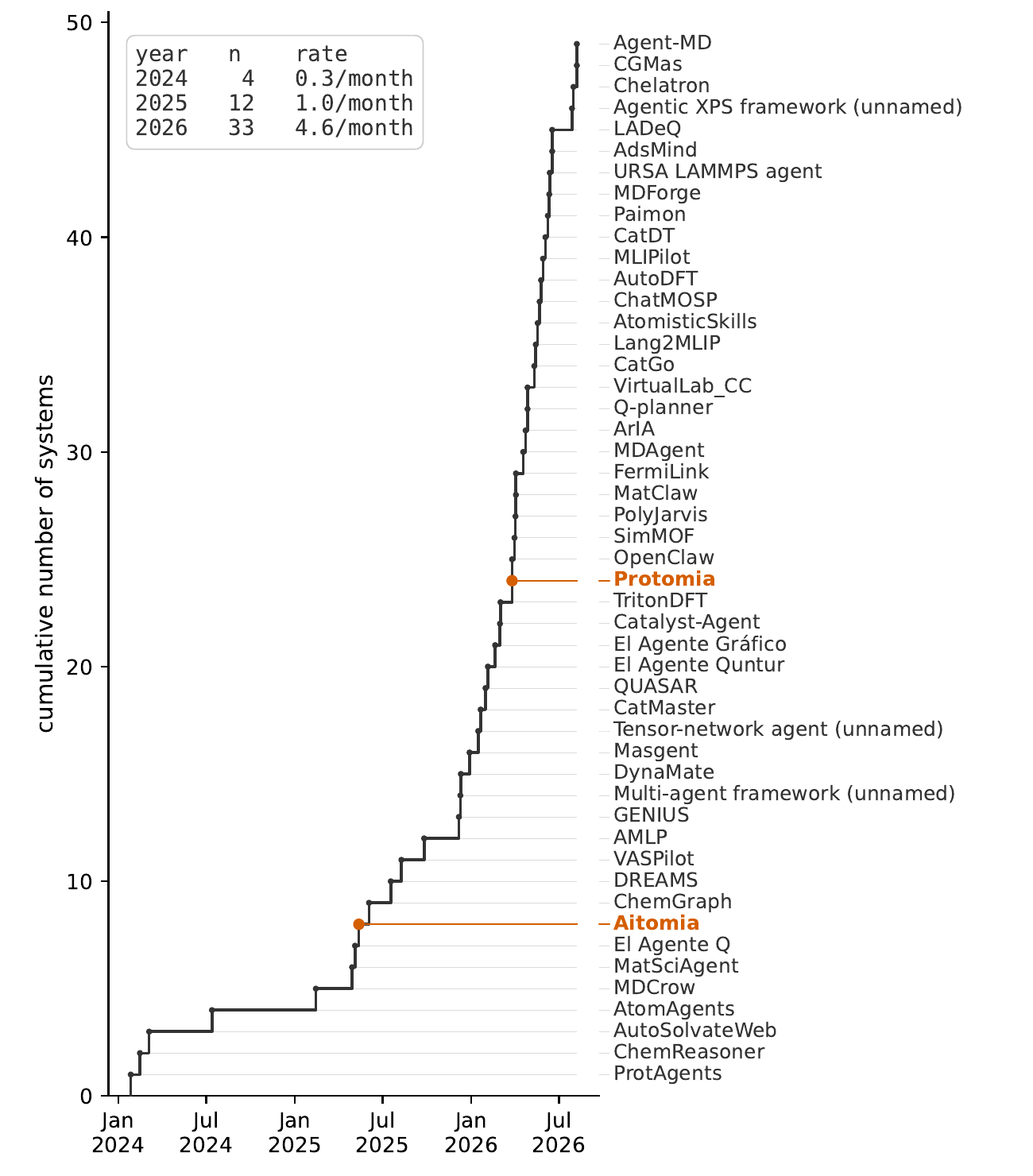
Figure 1 | Every agentic system in the survey, at its first public appearance. The inset gives the count and the rate for each year. Aitomia and Protomia are marked in colour.
The Perspective maps what these systems do, how much of a study each is handed — from a single calculation, to a full in silico experiment, to writing the paper — and what software runs them. No system yet demonstrates autonomy at the scale of a campaign or a research agenda, and every one reported so far still has a human in the loop.
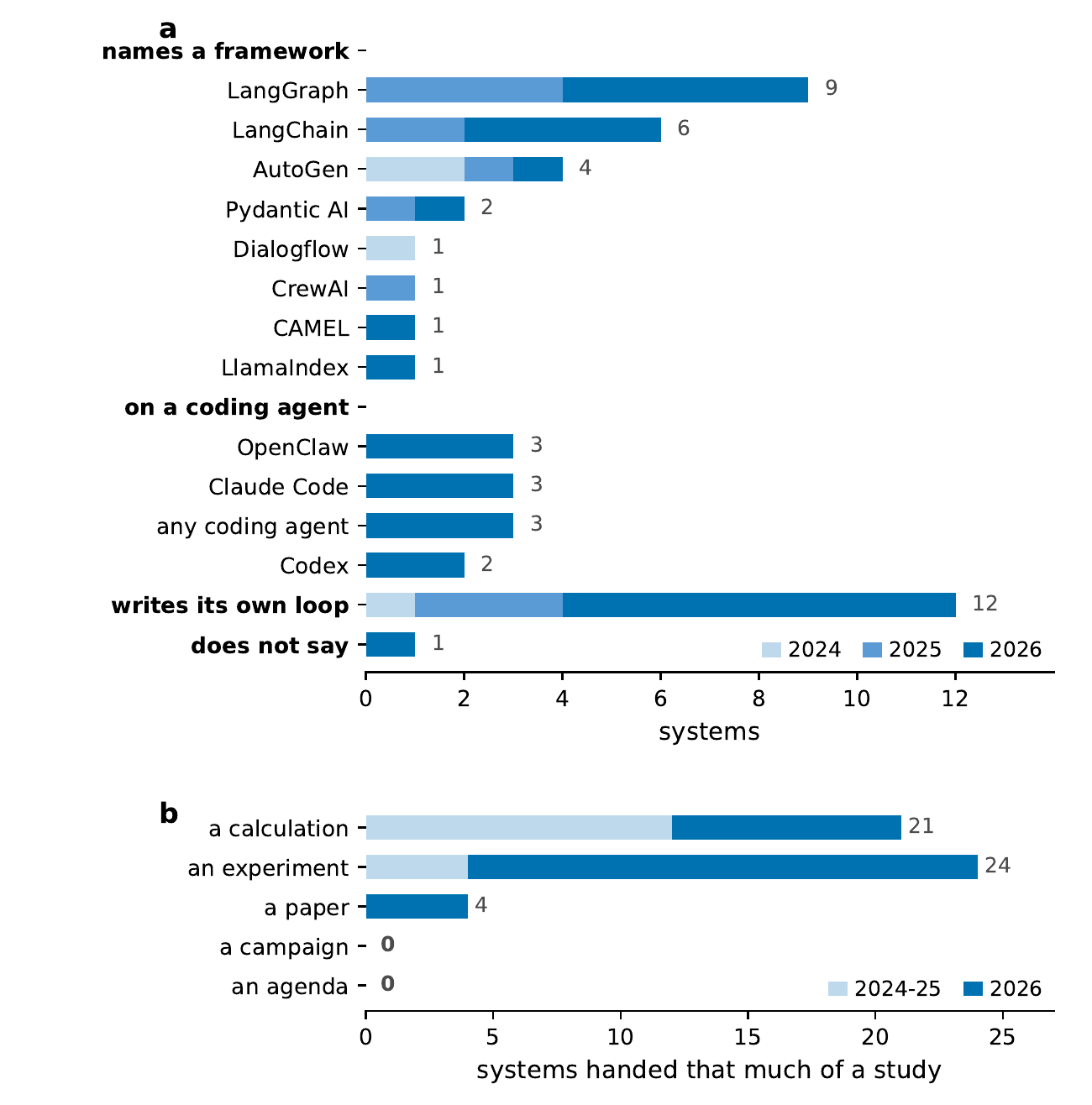
Figure 3 | What runs the agent, and how much of a study is delegated to it, split by era.
It also asks how much of this a reader can actually obtain: only 27 of the 49 state a licence, most ship no tests, and just four can be tried online without installing anything. One of those four is Aitomistic's own Protomia, which the Perspective uses as its worked example — asked for a reaction energy from a single question, and, in a later session, to write and compile a short paper on the same reaction.
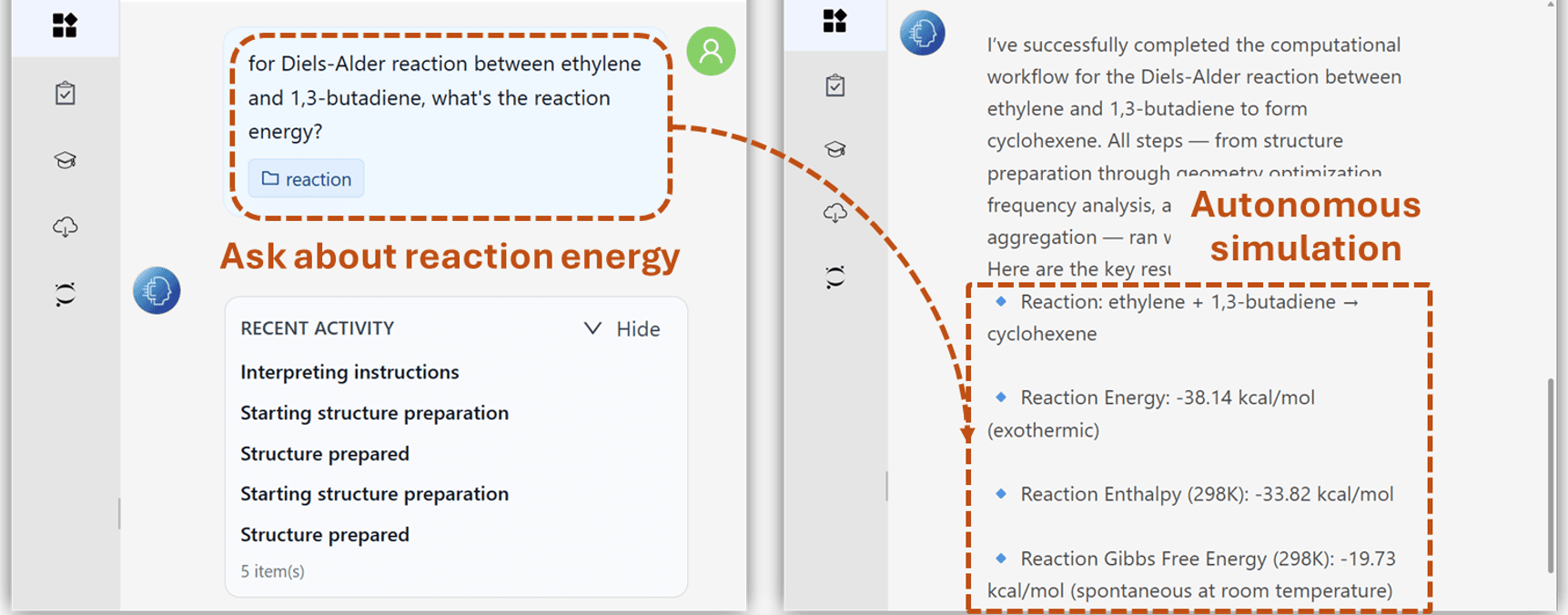
Figure 4 | Protomia asked for the reaction energy of the Diels–Alder reaction between ethylene and 1,3-butadiene: it prepares the structures, runs the calculations and reports the reaction energy, enthalpy and Gibbs free energy, choosing and executing the steps itself. Reproduced from the Protomia documentation under CC BY 4.0.
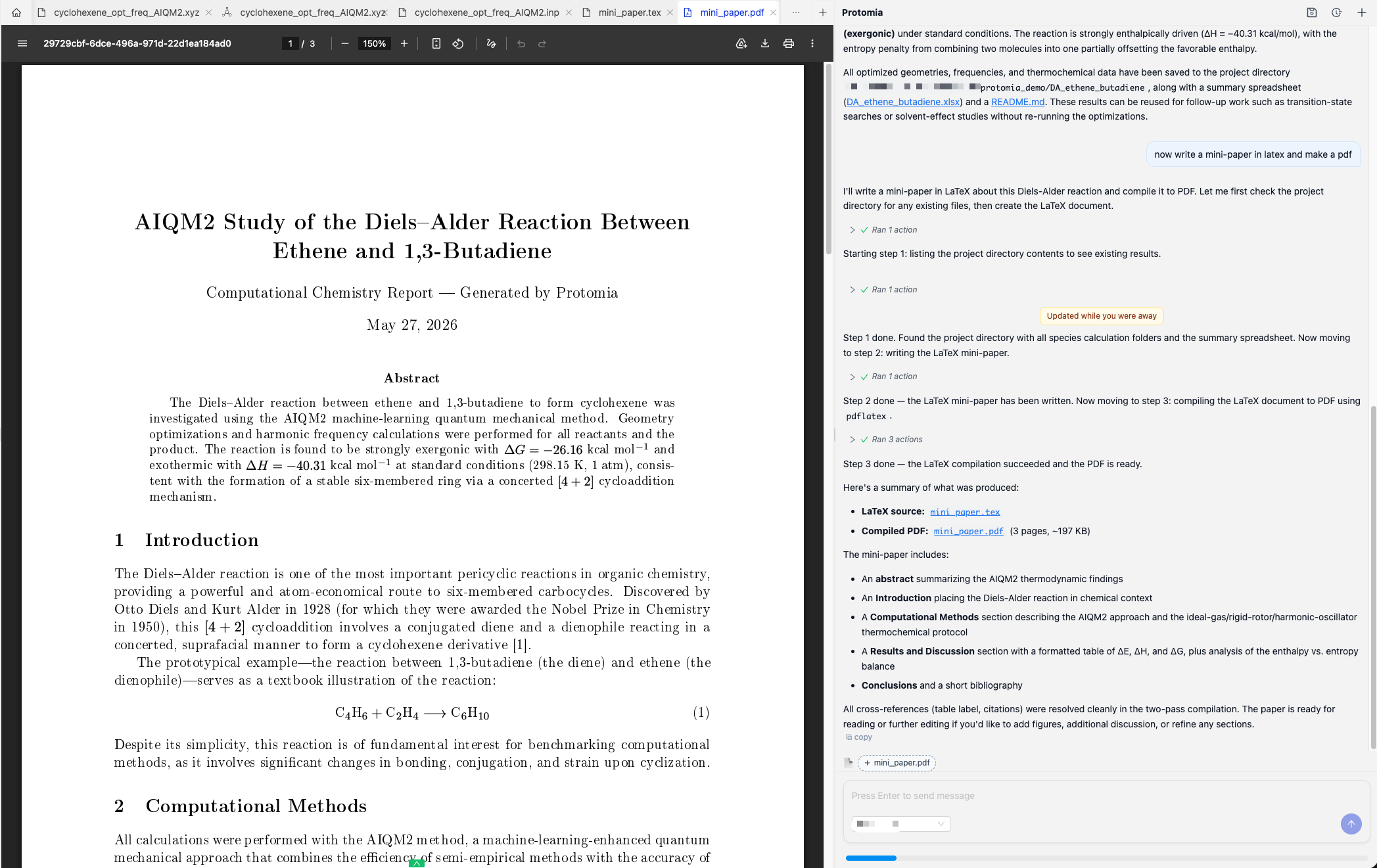
Figure 4 (continued) | In a later session, with the same reaction already run, Protomia is asked to write a short paper in LaTeX and compile it. It writes the document, compiles it and reports what it produced, with cross-references resolved and every empirical claim carrying provenance that a deterministic auditor checks before it finishes. Reproduced from the Protomia documentation under CC BY 4.0.
The survey, its database and the intermediate versions of the article were themselves assembled by the AI Dral Group, an AI research-agent collective — Protomia among the tools used — with the authors directing and verifying every step.
Full text (CC BY 4.0): arXiv:2608.18508