
Nature Communications: OMNI-P2x Universal Neural Network Potential for Excited-State Simulations
We are happy to share that our work on OMNI-P2x—universal neural network potential for excited-state simulations—has been published in Nature Communications. It is a joint work by Mikołaj Martyka, Xin-Yu Tong, Joanna Jankowska, and me, done across the continents (affiliations with Xiamen University and Aitomistic, China as well as with the University of Warsaw and Nicolaus Copernicus University in Toruń, Poland).
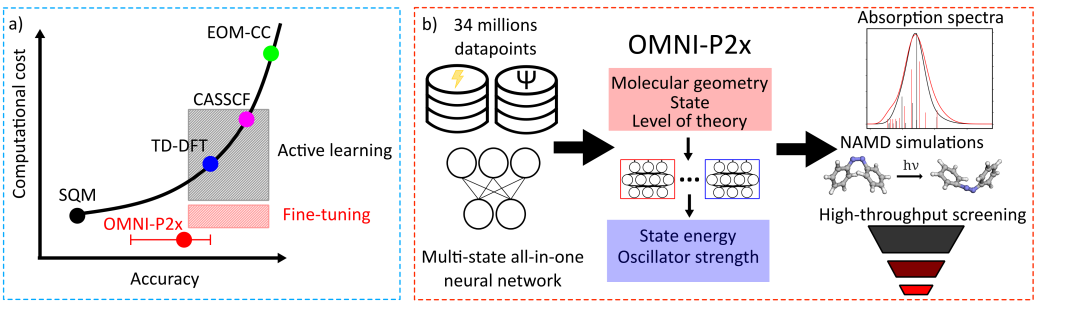
OMNI-P2x is the first universal neural network potential for ground and excited electronic states for a chemical space of small molecules. It offers a practical compromise: approaching TD-DFT accuracy at a lower cost, with room for improvement via fine-tuning for specific systems. We show applications in UV/Vis spectroscopy, photodynamics, and the rational design of visible-light-absorbing azobenzene systems.
OMNI-P2x is an important step toward making excited-state calculations more accessible, though there is still a lot of room for improvement and for extending its applicability domain. Encouragingly, even when OMNI-P2x cannot be used out of the box, it provides a good starting point for downstream tasks, e.g., enabling photodynamics simulations at levels of theory without analytical gradients (see our follow-up work in Chem. Sci. 2026, DOI: https://doi.org/10.1039/D5SC09557C).
Try OMNI-P2x Online: Simulations Powered by Protomia
You can now run OMNI-P2x calculations directly in your browser through the Aitomistic Hub—no software installation, no command line required. Simply visit aitomistic.xyz, describe your molecule and computational needs in natural language, and Protomia will automatically set up and execute the simulation. For example, you might enter:
Calculate the UV-Vis absorption spectrum of triphenylamine: first optimize the geometry with AIQM3, then compute the excited states with OMNI-P2x.
Protomia handles the entire workflow automatically—from geometry optimization to excited-state prediction—and returns visualized results within minutes. (The OMNI-P2x calculation itself takes only milliseconds; the total time includes geometry optimization, spectrum generation, and other steps.)
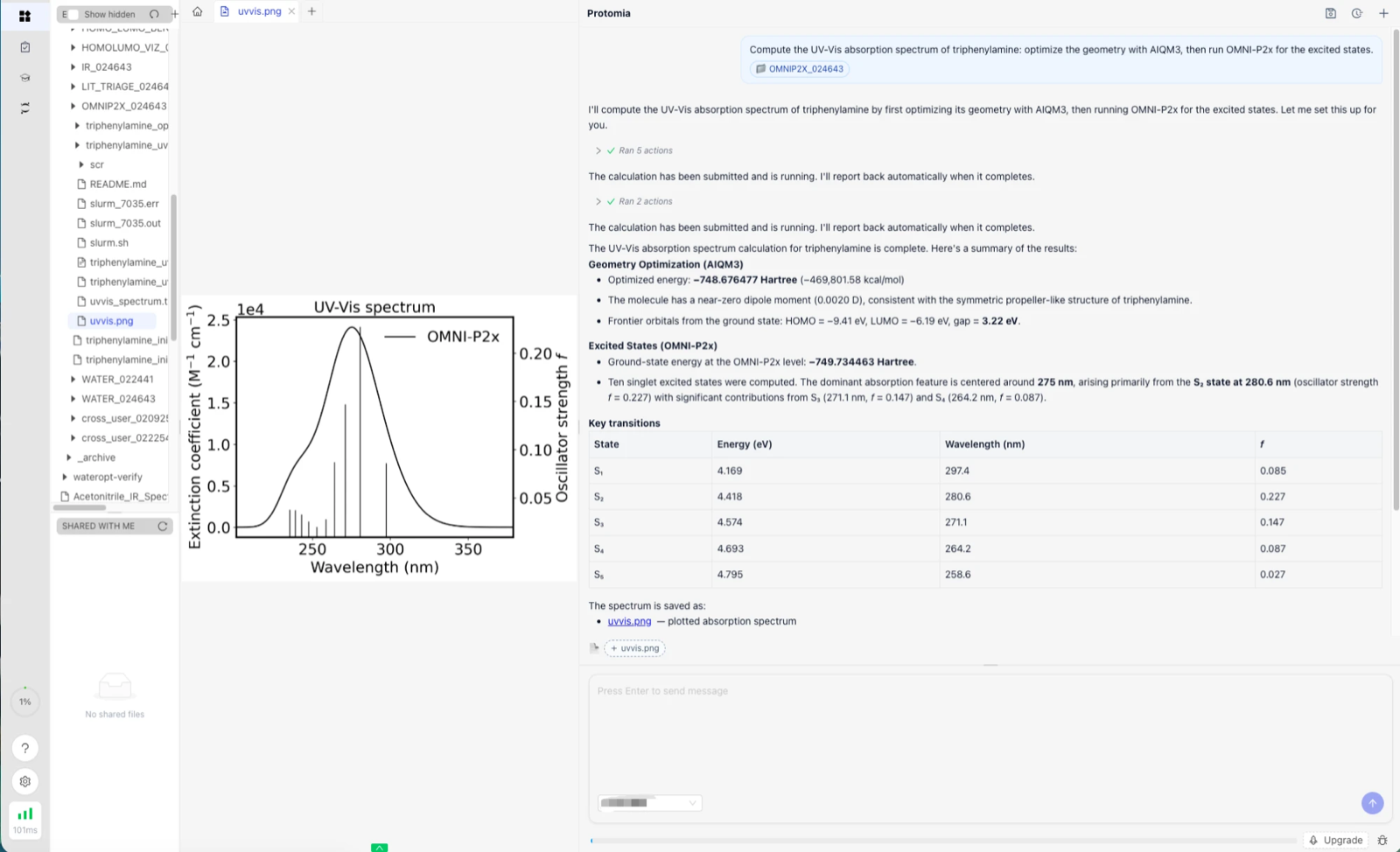
The Protomia interface on the Aitomistic Hub, showing a UV-Vis spectrum calculation request and its results. You can ask Protomia in your language.
Run OMNI-P2x on Your Computer
For users who wish to run calculations locally or integrate OMNI-P2x into their own computational pipelines, the method is freely available as part of the MLatom program—an open-source platform for machine learning atomistic simulations
Source code: github.com/dralgroup/mlatom
Tutorial: aitomistic.com/mlatom/tutorial_omnip2x.html
The tutorial provides a step-by-step guide to setting up OMNI-P2x calculations through the Python API, covering everything from basic single-point excited-state energy prediction to advanced workflows such as UV-Vis spectrum generation and non-adiabatic molecular dynamics.
Paper: Martyka, M., Tong, XY., Jankowska, J. et al. OMNI-P2x universal neural network potential for excited-state simulations. Nat. Commun. 2026, 17, 4949. https://doi.org/10.1038/s41467-026-71380-5.