
Capabilities
What Protomia Solution 2 helps computational chemistry researchers do.
Capabilities
Protomia is designed to support real computational chemistry work rather than isolated chat responses.
This page is the overview. For the full list of calculations, methods, engines and file types — and where the limits are — see Features.
Run Chemistry Workflows From Conversation
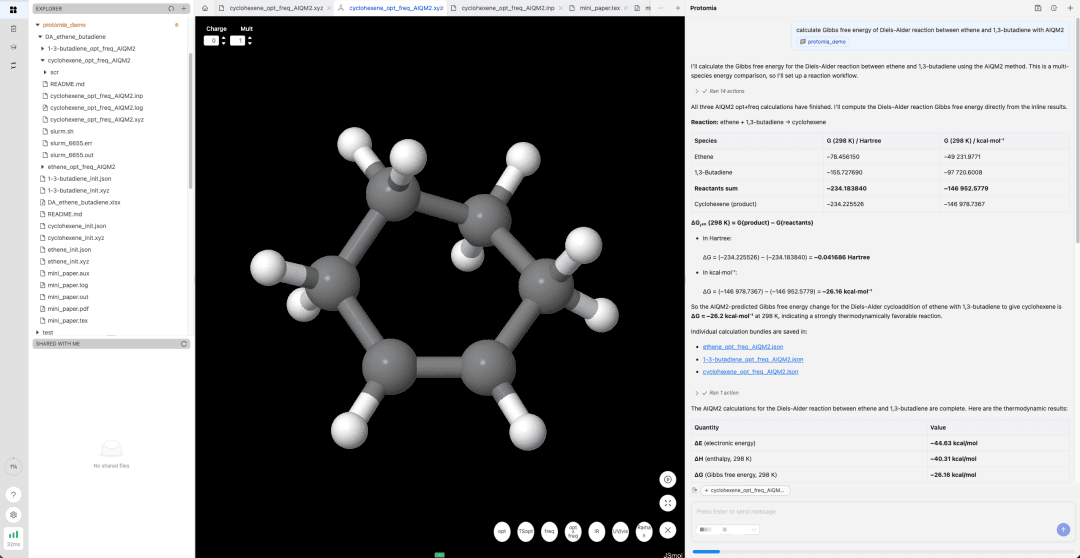
Protomia Solution supports conversation-driven workflows where a researcher starts from a question, describes a target calculation in plain language, and iterates on setup and interpretation in the same thread.
Supported work in this scope includes preparing and reviewing inputs, running calculations through connected tooling, inspecting outputs, and summarizing results for common molecular tasks such as single-point calculations, geometry optimization, transition-state search, frequencies, IR, Raman, UV-Vis, thermochemistry, and reaction-energy calculations.
Work With Real Cluster Jobs
In supported compute environments, Protomia Solution can work with real submitted jobs rather than only discussing them abstractly.
This includes preparing job-related files, submitting runs, monitoring queue or execution status, and returning to the same conversation when results are available. Supported environments depend on the connected setup, such as the Protomia Hub or configured cluster access available to the user.
Run Fast ML-Potential Simulations
Protomia Solution supports ML-potential workflows when that method is appropriate for the system and research question.
In that mode, it can help set up, run, and review faster simulations that complement higher-cost quantum chemistry workflows. These workflows are in scope when the user is intentionally choosing an ML-potential method for exploratory simulation, screening, or other cases where that level of approximation is suitable.
Ground Answers in Real Sources
Protomia Solution can use source materials during a session so explanations and workflow guidance stay tied to reference material instead of relying only on model memory.
Supported source materials include product or tool documentation, uploaded or linked PDFs, scientific literature, and other research documents available in the working context. This is useful for method explanations, citation lookup, implementation details, and checking assumptions against written sources.
Write Research Scripts And Notebooks
Many computational chemistry projects require scripts, notebooks, data cleanup steps, and workflow glue around the calculations themselves.
Protomia Solution supports that surrounding work by drafting, inspecting, and revising research code used to prepare runs, process outputs, analyze results, or package a workflow into a reusable notebook or script.
Learn From Curated Materials
When users need examples, explanations, or starting points, Protomia Solution can work from curated learning materials in its available knowledge sources.
Examples mentioned in scope for this release include MLatom tutorials and Computational Chemistry and AI course materials. In practice, this means the system can use those materials as references for explaining a method or assembling a repeatable workflow pattern.
Move From Results To Writing
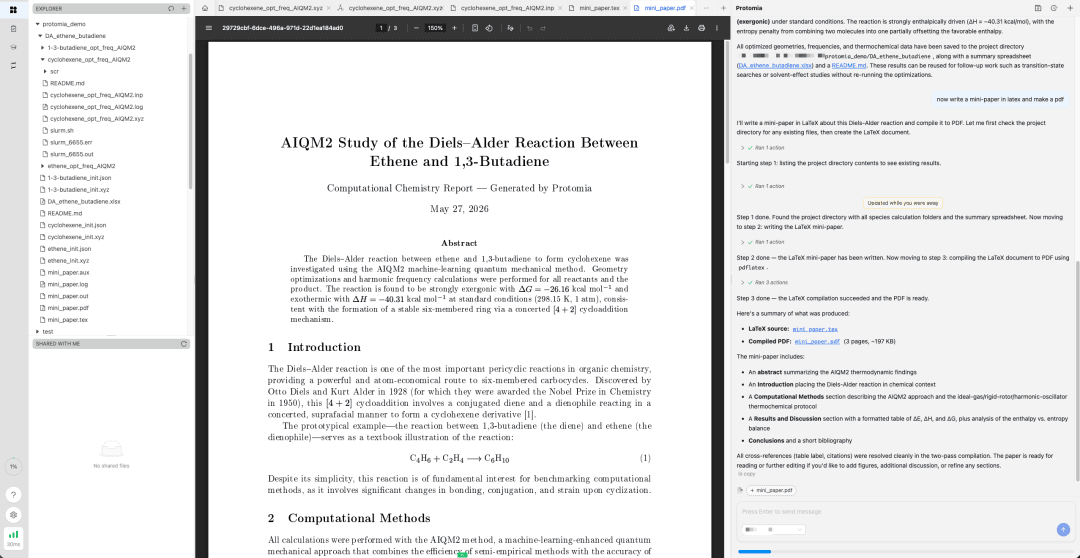
Research workflows often continue from calculation outputs into figures, notes, and manuscript preparation.
Protomia Solution supports that handoff by helping organize results, draft or revise manuscript text, prepare reviewer responses, look up citations, and work with common document formats such as Word, LaTeX, and PDF-oriented editing workflows.
Bring Your Own Skills
In this context, skills means reusable instruction files that describe preferred tools, methods, constraints, or workflow steps.
Protomia Solution can read Claude-style skills or similar structured instructions supplied by a research group, so project-specific methods, templates, writing conventions, and tool usage rules can be applied consistently during a session.
Related Pages
Figures on this page are © Aitomistic, licensed under CC BY 4.0 (full licence text).